
What Is An AFCI?
AFCI is an Arc-Fault Circuit Interrupter that detects electrical patterns linked to arcing and disconnects power from the affected circuit. An AFCI helps reduce fire risk from damaged wires, loose connections, or crushed insulation. The device may be installed as a circuit breaker or as a receptacle, depending on the circuit design.
Quick Facts About AFCI
Category
Electrical safety device
Used for
Detecting hazardous arcing
Common confusion
AFCI and GFCI perform different protective functions
Also called
Arc-Fault Breaker, Arc-Fault Circuit Interrupter
Often discussed with
Electrical Safety Inspection, Electrical Troubleshooting
Key Takeaways About AFCI
- AFCI protection responds to arcing patterns, not ordinary overloads.
- AFCI devices may appear at the panel or at a receptacle.
- AFCI is not the same as GFCI protection.
How AFCI Works
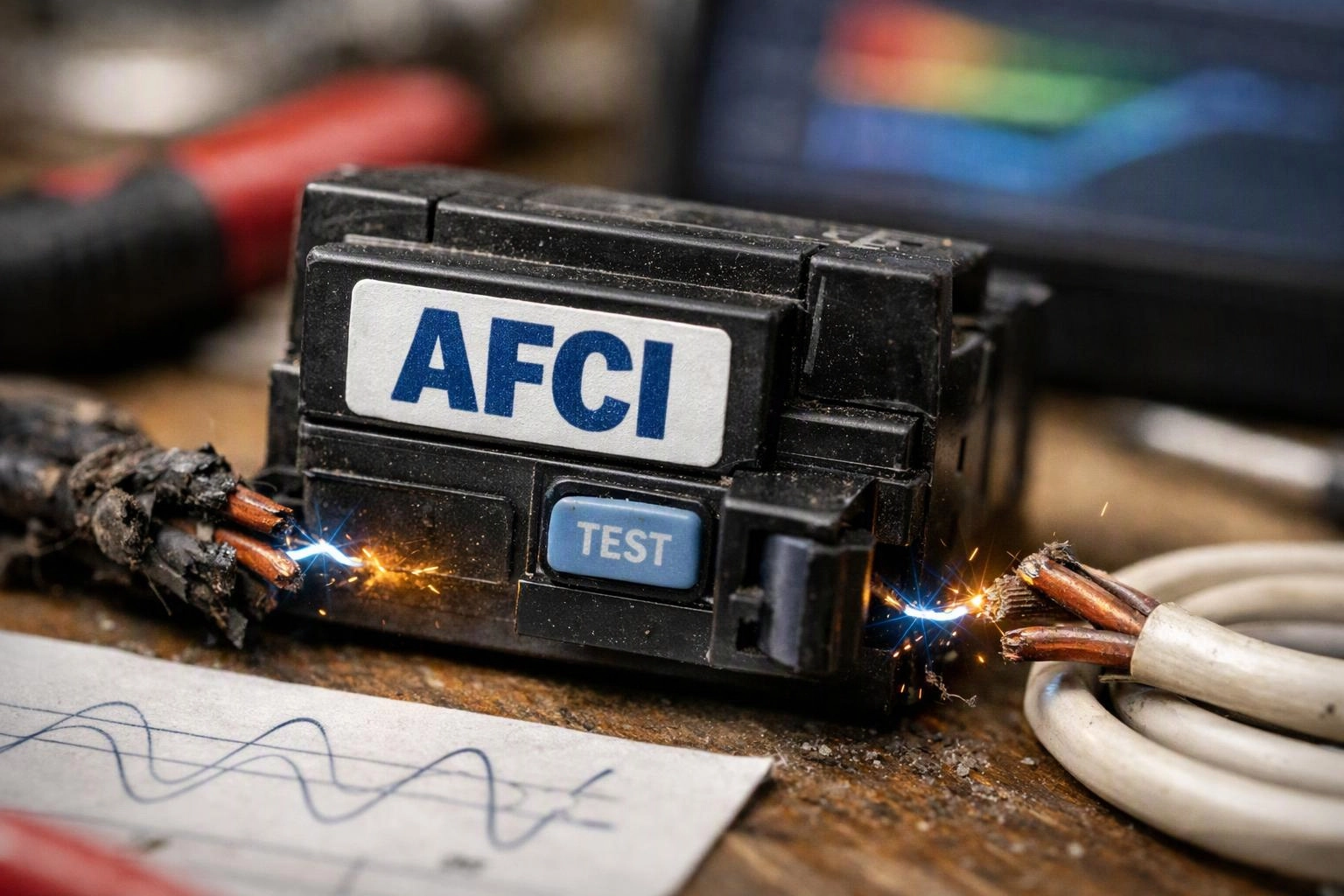
AFCI protection monitors the electrical current in a circuit for patterns that resemble an unwanted arc. An arc can occur when current jumps across a damaged connection or a gap in insulation. When the device recognizes that pattern, the circuit breaker or receptacle opens the circuit and stops the flow of electricity.
Related glossary terms: Circuit Directory, Single-Pole Breaker, Test/Reset Button.
AFCI protection may be built into a breaker at the electrical panel or installed in a receptacle serving a circuit. The device includes a test function that checks whether its internal sensing and interruption features respond correctly. AFCI protection differs from GFCI protection, which responds to current leaving its intended path through a ground fault.

From the Center Electric Service team
When we inspect AFCI protection, we check the device, its test function, the circuit connections, and the circuit directory. We also investigate repeated trips because a trip can point to damaged wiring, a faulty device, or an appliance problem. Our team records findings as part of an Electrical Safety Inspection.
AFCI in Practice: A Real-World Example
During an Electrical Safety Inspection, an AFCI breaker may trip when a circuit has a damaged cord or a loose connection. We trace the circuit, identify the source of the arcing pattern, and verify the protective device after the condition is corrected.
Related Terms
Circuit Directory
Circuit Directory is a labeled panel schedule that identifies which rooms, outlets, appliances, or equipment each…
Single-Pole Breaker
Single-Pole Breaker is a circuit protection device that controls one energized conductor and supplies power to…
Test/Reset Button
A Test/Reset Button is a built-in control on a ground-fault circuit interrupter receptacle that checks and…
Short Circuit
A short circuit is an unintended electrical connection that creates a low-resistance path for current. The…
Center Electric Service
Have Questions About AFCI?
Contact Center Electric Service for practical guidance on AFCI and related 24 hour electrician work in Riverside.