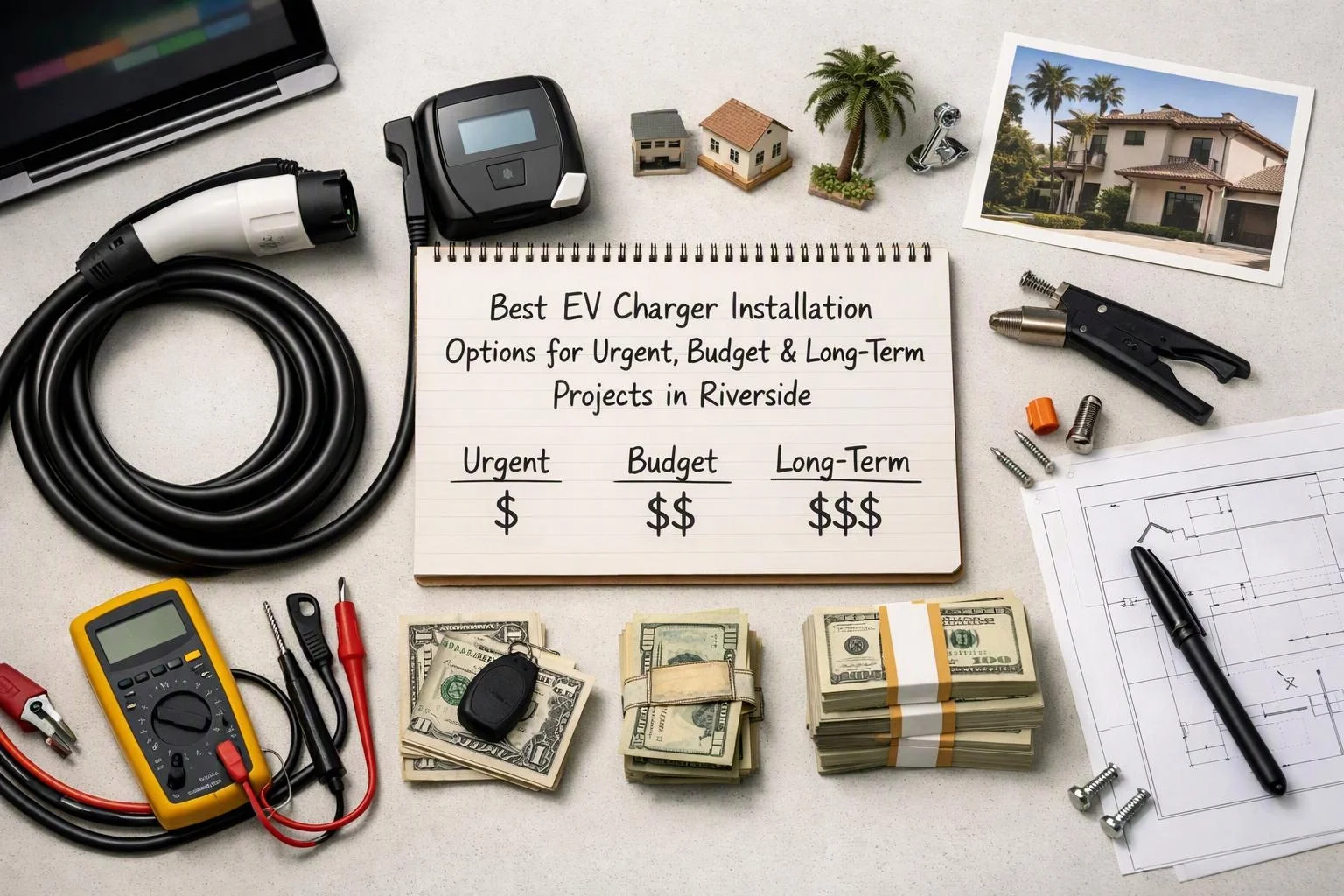
Best EV charger installation Options for Urgent, Budget & Long-Term Projects in Riverside
EV charger installation options in Riverside depend on urgency, available electrical capacity, charging goals, and future expansion; Center Electric Service evaluates the electrical system, explains the trade-offs, and provides free estimates.
Options at a Glance
Charging options fit different project priorities. We match the equipment and electrical work to the way you plan to use your electric vehicle.
Which EV Charger Installation Option Fits Your Project?
The best EV charger installation option depends on whether the immediate priority is restoring charging access, controlling project scope, or preparing the electrical system for future demand.
An urgent project starts with safety and fault diagnosis. A budget project focuses on charger compatibility, the existing electrical panel, and practical circuit routing. A long-term project gives more attention to load planning and future expansion.
Urgent EV Charging Needs: Start With Electrical Safety
An urgent EV charging project should begin with identifying the electrical fault, unsafe condition, or loss of charging access before selecting equipment.
We inspect the charger fault, dedicated circuit, circuit breaker, outlet condition, and electrical wiring. Our team then explains whether the existing charging station can be repaired or whether the installation scope needs to change.
Disconnect charging equipment if you notice heat, burning odors, visible damage, or repeated breaker trips. We can assess the electrical system before charging resumes.
Signs Your EV Charger Project Needs Electrical Attention
EV charger symptoms can show that the circuit, wiring, outlet, or equipment needs attention. We use these signs to guide the electrical inspection.
Budget-Focused EV Charger Installation Options
A budget-focused EV charger project controls scope by matching the charger and installation route to the existing electrical system without adding work that the current charging goal does not require.
We review the existing electrical capacity, charger location, circuit routing, and equipment selection. A Level 2 charger may require a dedicated circuit, suitable wire gauge, and circuit protection that match the charger requirements.
Our team can explain whether an indoor charger, outdoor charger, or another compatible charging setup fits the property and the available panel capacity. Request an EV charger installation assessment for a project-specific quote.
What Changes the Cost of This Riverside Charging Project?
The cost of this EV charger installation changes with the electrical capacity, circuit path, mounting location, equipment requirements, and access needed for safe installation.
| Project factor | What we review | Possible effect on scope | Quote detail |
|---|---|---|---|
| Electrical panel capacity | Available capacity and panel condition | May support direct installation or indicate a panel upgrade | Panel work is identified separately |
| Dedicated circuit | Circuit rating, breaker, and wire gauge | Determines circuit protection and wiring needs | Circuit requirements are included in scope |
| Wire distance and access | Wall or ceiling access and routing path | Changes conduit, wiring, and access work | The route is reviewed before quoting |
| Indoor or outdoor location | Mounting surface, weather exposure, and charger compatibility | Affects mounting and equipment requirements | Location-specific work is listed in the quote |
Long-Term EV Charging Plans for Homes and Properties
A long-term EV charging plan prioritizes electrical capacity, equipment location, and future expansion so the installation supports changing vehicle and household needs.
We consider future EV ownership, multiple EV charging, load planning, and the condition of the electrical panel. A panel upgrade for EV charging may be appropriate when the existing system cannot support the planned electrical load.
An expandable electrical system can make future charging changes easier to plan. We identify practical options without adding work that the property does not need.
Common Causes of EV Charger Installation Problems
EV charger installation problems often begin with a mismatch between the charger requirements and the electrical system. We trace the cause before changing equipment or wiring.
How to Prevent Charging Problems After Installation
Safe charger operation depends on suitable equipment, sound connections, and an electrical load that remains within the system’s capacity. We explain the operating conditions that matter for the selected setup.
How We Match the Charger Installation to Your Priorities
Center Electric Service matches the installation plan to your charging goals, electrical conditions, access requirements, and preferred project scope.
What Our Free Estimate Covers
Our free estimates cover the charger location, circuit requirements, panel condition, access needs, and installation scope.
We use the assessment to explain what the existing electrical system can support and what added work may be needed. You receive a quote based on the conditions we review at the property.
Riverside Conditions That Can Affect Charger Planning
Hot, dry conditions across much of Riverside County can influence charger circuit capacity assessments and electrical equipment operating conditions, especially at exposed property locations.
We consider cooling load, charger circuit capacity, equipment placement, and weather exposure during the electrical assessment. These conditions can matter when an outdoor charger or exposed electrical equipment is part of the plan.
How to Choose an EV Charger Installation Plan
An EV charger installation plan should be checked against the vehicle, property, electrical system, and future charging needs.
Ready to Plan Your Riverside EV Charger Installation?
Your next step is to request an EV charger installation assessment from Center Electric Service so the project scope can match your urgency, budget priorities, and long-term plans.
We can review your charger location, electrical panel, dedicated circuit needs, and future charging goals before preparing a quote. You can also review our service information for Riverside project planning.
Questions About Choosing an EV Charger Installation
Which EV charger installation option is best for a budget-focused project in Riverside?
A budget-focused EV charger installation that uses suitable existing electrical capacity is usually the best fit when the charging goal does not require broader system changes. Center Electric Service reviews the panel, circuit routing, charger location, and equipment compatibility before preparing the quote.
What should I check before choosing an EV charger installation location?
An EV charger installation location should provide a practical circuit route, suitable mounting surface, safe cable access, and protection from damaging weather exposure. We also check whether the location supports the selected charger and the vehicle’s charging needs.
Can an existing electrical panel support an EV charger?
Yes, an existing electrical panel can support an EV charger when its capacity, circuit protection, wiring, and available space match the charger requirements. We complete a load assessment and identify whether the installation needs a dedicated circuit or panel upgrade.
What changes the quote for an EV charger installation project?
An EV charger installation quote changes with panel capacity, circuit routing, wire distance, access conditions, charger compatibility, and indoor or outdoor placement. We review these conditions and provide a quote that explains the proposed installation scope.
Should long-term EV charging plans include electrical capacity for future expansion?
Yes, long-term EV charging plans should consider electrical capacity for future expansion when you expect additional vehicles or higher charging demand. We review load planning, panel condition, charger location, and the practical path for future electrical work.
Related Resources
EV Charger Installation Process: Home Assessment to Final Testing
Compared ToLevel 1 vs. Level 2 EV Charger Installation: Which Charging Option Is Right?
Brand vs BrandEV Charger Installation Providers Compared: How to Choose the Right Electrician
Brand vs BrandCenter Electric Service vs Local EV charger installation Alternatives in Riverside: Side-by-Side Comparison