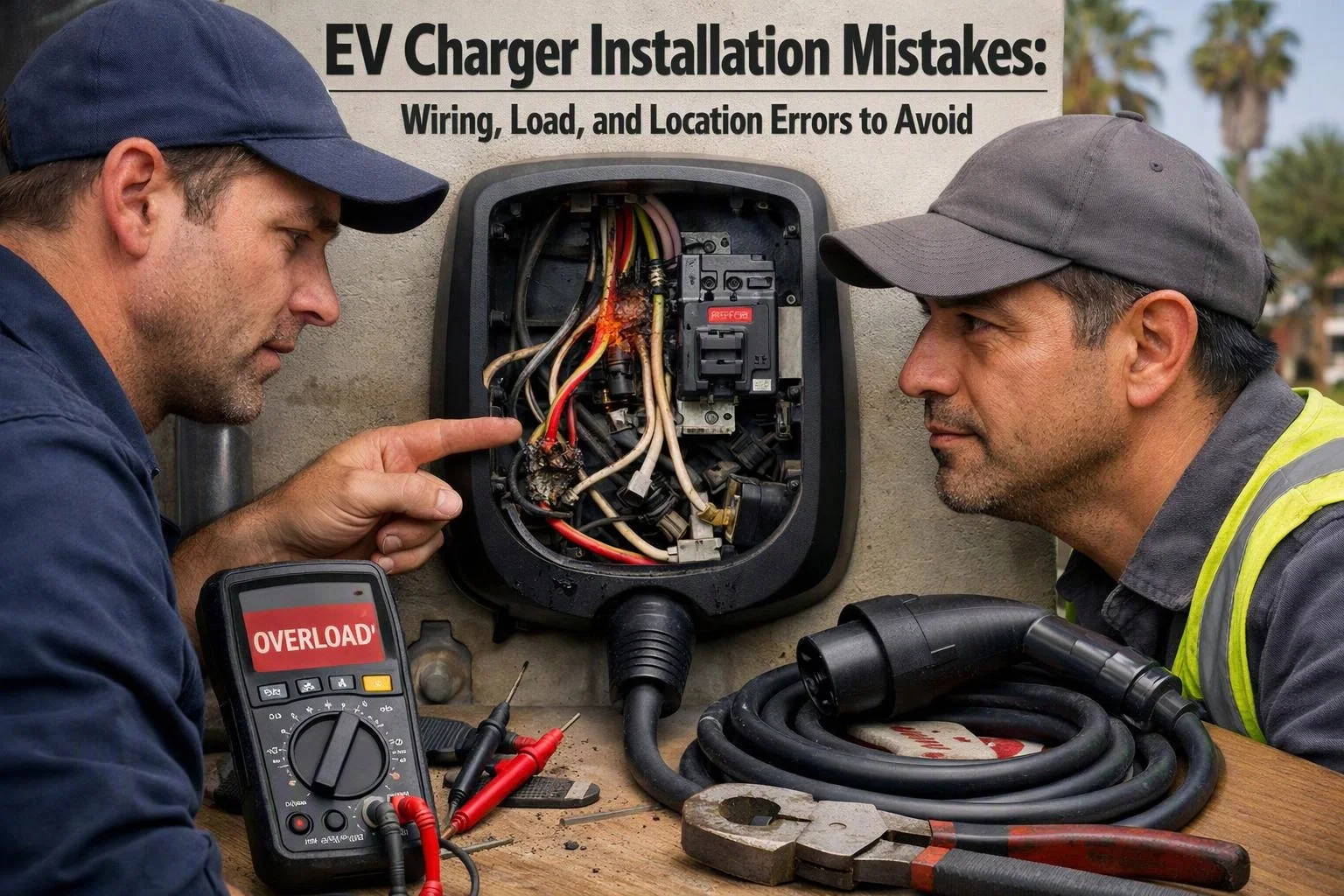
EV Charger Installation Mistakes: Wiring, Load, and Location Errors to Avoid
EV charger installation mistakes often involve undersized wiring, inadequate electrical capacity, poor placement, missing protection, or incorrect equipment settings. Center Electric Service checks the existing electrical system, charger location, load-management needs, and backup-power requirements before completing the installation.
Get a Free EstimateWhich EV Charger Installation Mistakes Create the Most Risk?
EV charger installation mistakes create the most risk when circuit sizing, service capacity, location, protection, or equipment setup is incorrect. These errors can affect electrical safety and the reliable operation of electric vehicle supply equipment.
Center Electric Service reviews the installation against applicable National Electrical Code requirements, the equipment instructions, and the conditions at the property.
Mistake: Using Wiring That Is Too Small for the EV Charger
Undersized conductors cannot safely carry the charger’s continuous electrical load. The problem can happen when conductor sizing is based only on the breaker label, without checking ampacity, copper or aluminum wire characteristics, conductor temperature, and voltage drop.
We select wiring that matches the charger, circuit breaker, installation method, and expected load. We replace damaged or unsuitable conductors and verify that the terminations are protected and secure.
Correction cost depends on the wire type, route, access, and whether the existing conduit can be reused. We review those conditions before preparing an estimate.
Mistake: Connecting the Charger to an Overloaded Electrical Panel
An EV charger can overload an electrical panel when the whole-home electrical load already uses most of the available service capacity. A breaker can fit in a panel while the service still lacks the capacity shown by a proper load calculation.
Our team inspects the electrical panel, service entrance, breaker capacity, and major household loads. We then identify whether the correction requires circuit changes, panel work, or a load-management plan.
Correction cost changes with the panel condition, service capacity, wiring route, and required electrical work. An estimate follows our review of those job conditions.
Mistake: Choosing a Charger Location Without Planning the Cable Path
A poor EV charger location can leave the charging cable crossing a parking space, walkway, or vehicle path. The error often begins when the charger is placed near the panel without planning parking access, conduit routing, weather exposure, and trip hazards.
We plan the cable path with the parking space, connector reach, wall position, and conduit route in mind. Our team protects the route and keeps the charging cable from creating avoidable physical hazards.
Correction cost depends on the distance, surface, conduit routing, and access to the installation area. We include those factors in the estimate.
Mistake: Skipping Ground-Fault and Overcurrent Protection
Missing ground-fault protection or overcurrent protection can leave people and equipment exposed to fault conditions. The circuit also needs a suitable equipment grounding conductor and an accessible disconnecting means where required.
We match the circuit breaker and protection method to the charger and wiring system. We inspect grounding paths, terminations, and disconnecting means before the equipment is energized.
Correction cost depends on the existing breaker, panel configuration, grounding path, and work needed to correct the circuit.
Mistake: Installing the Charger on an Unsuitable Wall or Surface
An unsuitable mounting surface can loosen the charger enclosure or damage the equipment over time. The issue may involve weak structural support, incorrect mounting hardware, or an outdoor installation that lacks the needed NEMA enclosure.
We check the wall mounting surface, mounting bracket, fasteners, and enclosure rating. Our crew provides structural support and weather-resistant equipment when the location requires it.
Correction cost depends on the wall condition, mounting method, enclosure requirements, and access to the surface.
Mistake: Ignoring Moisture, Heat, and Physical Damage
Moisture, heat, impact, and poor fittings can damage a charger circuit. Water intrusion may enter through conduit fittings, while exposed cord sections can suffer abrasion or vehicle impact.
We inspect weather exposure, conduit fittings, cord protection, and the equipment enclosure. We correct entry points and protect the circuit from the physical conditions at the site.
Correction cost depends on damaged components, weather-resistant equipment needs, conduit changes, and the route’s accessibility.
Mistake: Forgetting Load Management for Multiple High-Demand Loads
Multiple high-demand loads can push service demand beyond available capacity when an EV charger operates with an electric water heater or heat pump. A basic circuit connection does not automatically coordinate these loads.
We evaluate the service demand and determine whether EV charger load management or an energy management system can control the combined load. Our load-management installation connects the equipment according to its operating requirements.
Correction cost depends on the existing service, control equipment, wiring, and access to the connected loads.
Mistake: Misconfiguring Charger Settings or Terminating Connections Incorrectly
Incorrect charger settings, dip switches, software settings, or terminal connections can cause nuisance shutdowns and unsafe operation. Loose connections can also create heat at the terminal block.
We follow the charger instructions, verify terminal torque specifications, inspect each connection, and confirm the charger settings during commissioning. Our testing checks that the equipment responds correctly under operating conditions.
Correction cost depends on whether the issue is a setting, a damaged terminal, a wiring correction, or a broader commissioning problem.
Mistake: Treating Bidirectional Charging Like a Standard EV Charger
Bidirectional EV charging requires equipment that can safely move power between the vehicle, home, and electrical system. Vehicle-to-home power also requires compatible transfer equipment, islanding protection, and planning for backup power and energy storage.
We design bidirectional EV backup-power installation around the vehicle, charger, home wiring, transfer equipment, and required operating controls. We verify that the system separates from the utility supply when backup operation begins.
Correction cost depends on the bidirectional EV charger, transfer equipment, energy storage, wiring route, and site access.
How We Check an EV Charger Installation Before It Is Used
Center Electric Service checks the electrical capacity, circuit installation, equipment connections, charger configuration, and operating behavior before the charging system is placed into regular use.
Our process connects the electrical load assessment to the final commissioning test. Each step helps identify a wiring, protection, connection, or operating problem before home EV charging becomes routine.
What Changes the Cost of Correcting an EV Charger Installation Mistake?
The cost of correcting an EV charger installation mistake depends on the wiring condition, available electrical capacity, correction required, cable route, equipment type, and access to the installation area. Center Electric Service provides Free Estimates Available after reviewing those job conditions.
Electrical correction work may involve conduit routing, panel upgrades, load management, or bidirectional charging equipment. We explain which correction the installation needs and what our estimate includes.
Site access also affects the work because concealed wiring, difficult surfaces, and restricted equipment locations can change the correction path.
When Should You Call Center Electric Service About an EV Charger?
Call Center Electric Service when the charger requires new circuit wiring, the electrical panel may lack capacity, the installation needs load management, or bidirectional charging will connect to home backup power.
These situations involve electrical design, testing, and equipment coordination that should not be handled by guesswork. We inspect the installation and explain the safest correction path.
For installation planning, our Electric Vehicle Charger Installation service covers the electrical assessment, equipment connection, and commissioning work needed for the site.
How to Plan a Safer EV Charger Installation
A safer EV charger installation starts with an electrical assessment, continues with equipment and location planning, and ends with testing that confirms the circuit and charger operate as intended.
Choose the charger after reviewing service capacity, future electrical demand, parking access, cable routing, weather exposure, and backup-power goals. We use that information to plan a dedicated circuit, protection, mounting, and configuration that fit the property.
When future loads may include a heat pump, electric water heater, or bidirectional EV charger, we include load management in the design discussion. Contact Center Electric Service to review the installation conditions and request an estimate for the required work.
Questions About Avoiding EV Charger Installation Mistakes
Can an EV charger overload a home's electrical panel?
Yes, an EV charger can overload a home's electrical panel when existing whole-home demand leaves insufficient service capacity. Center Electric Service completes a load calculation and reviews the panel before selecting the circuit or load-management approach.
Does an EV charger need its own circuit?
Yes, an EV charger generally needs a dedicated circuit designed for its continuous electrical load. We verify conductor sizing, breaker capacity, equipment grounding, protection, and the charger instructions before connecting the equipment.
Can an EV charger be installed outdoors?
Yes, an EV charger can be installed outdoors when the equipment, enclosure, mounting, wiring, and fittings suit the weather exposure. We plan for water intrusion, temperature exposure, impact protection, and safe cable routing.
What happens if EV charger wiring is undersized?
Undersized EV charger wiring can overheat, create voltage drop, and fail to support the intended continuous electrical load. We inspect the conductors, ampacity, route, terminations, and protection before correcting the circuit.
Can load management avoid an electrical panel upgrade?
Load management may avoid a panel upgrade when the existing service and equipment can safely support coordinated demand. We complete a load calculation and assess the panel, EV charger, and other high-demand loads before choosing that path.
Is bidirectional EV charging installed the same way as a standard charger?
No, bidirectional EV charging requires additional planning for vehicle-to-home power, transfer equipment, islanding protection, backup power, and energy storage. We design and commission the system around those operating requirements.